Good Papers

Showing papers from ELLIS Institute Tübingen, MPI-IS Show all papers

45%Niche pick
?Niche pickVote to see the score

Fixed-Point Reasoning: Stable and Adaptive Deep Looped Models

Sajad Movahedi, Shlomo Libo Feigin, Vera Milovanović, Alexander Theus and 4 more

Sydney Poster Session 3, Wed, Dec 9, 10:00 AM–1:00 PM, Hall 1-4 · Published 2026

– ReadersNo votes yet
0/20 AI panelreviewers recommend it

Readers and the AI panel: vote on this paper to see what they said.

Only vote on papers you've read. Sign in with GitHub to vote.

AI panel: 0 of 20 reviewers recommend it
lenient 0/5
medium 0/10
strict 0/5
80%Must read
?Must readVote to see the score

FutureSim: Replaying World Events to Evaluate Adaptive Agents

FutureSim replays real-world events chronologically to benchmark adaptive AI agents forecasting future news, finding top accuracy at only 25%.

Shashwat Goel, Nikhil Chandak, Arvindh Arun, Ameya Prabhu and 4 more

Sydney Poster Session 2, Tue, Dec 8, 5:00 PM–8:00 PM, Hall 1-4 · Published 2026 · ▲ 6 on Hugging Face · Code ★ 56

– ReadersNo votes yet
12/20 AI panelreviewers recommend it

Readers and the AI panel: vote on this paper to see what they said.

Only vote on papers you've read. Sign in with GitHub to vote.

AI panel: 12 of 20 reviewers recommend it
lenient 5/5
medium 6/10
strict 1/5
91%Must read
?Must readVote to see the score

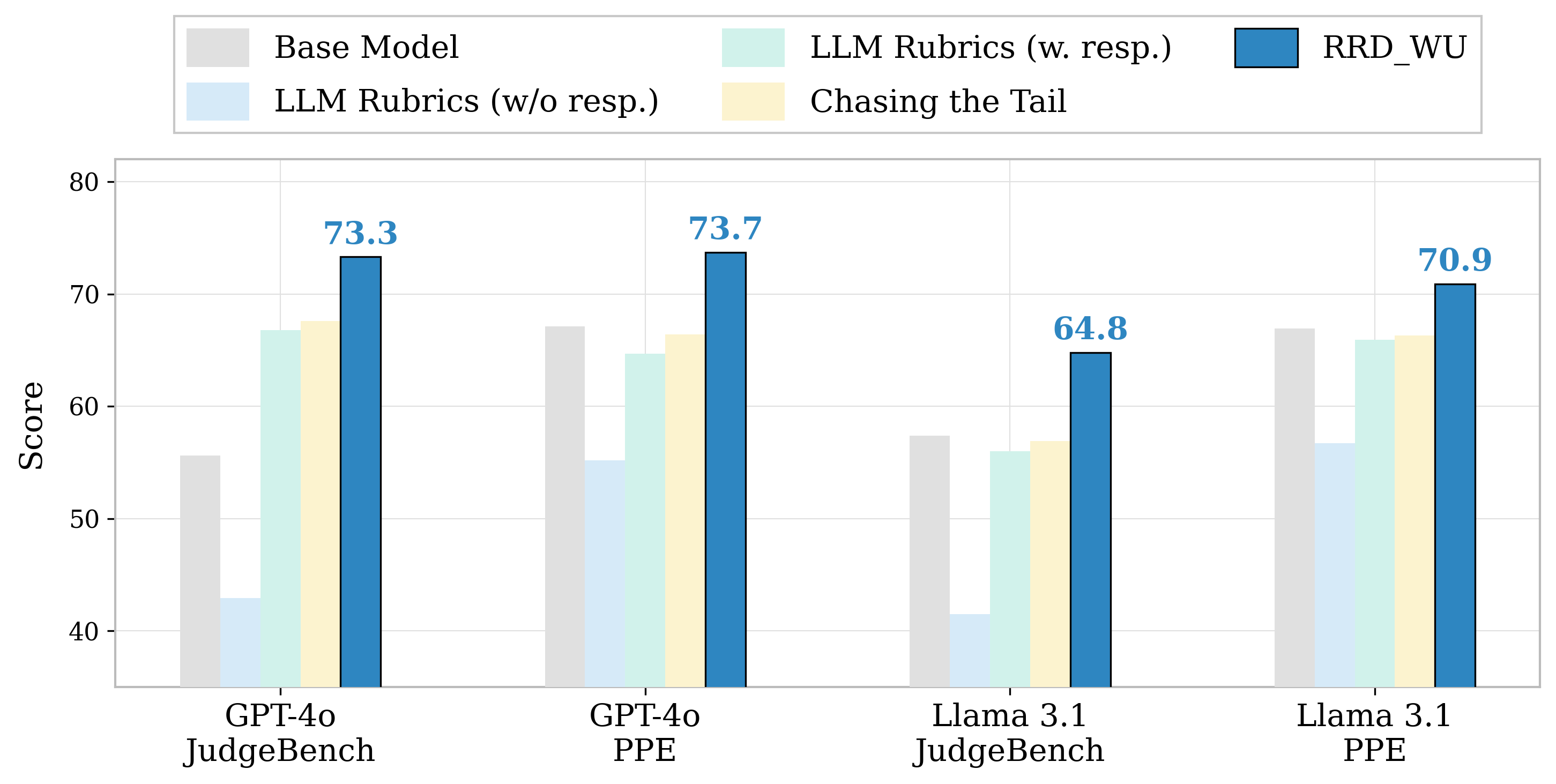
Rethinking Rubric Generation for Improving LLM Judge and Reward Modeling for Open-ended Tasks

RRD refines rubrics via recursive decomposition and filtering to improve LLM judge accuracy and reinforcement training rewards on open-ended tasks.

William Shen, Xinchi Qiu, Chenxi Whitehouse, Lisa Alazraki and 5 more

Sydney Poster Session 6, Thu, Dec 10, 5:00 PM–8:00 PM, Hall 1-4 · Published 2026

– ReadersNo votes yet
17/20 AI panelreviewers recommend it

Readers and the AI panel: vote on this paper to see what they said.

Only vote on papers you've read. Sign in with GitHub to vote.

AI panel: 17 of 20 reviewers recommend it
lenient 5/5
medium 10/10
strict 2/5
71%Highly rated
?Highly ratedVote to see the score

Towards Understanding Self-Pretraining for Sequence Classification

Self-pretraining improves sequence classification by learning proximity-biased attention patterns that supervised training misses from random initialization.

Omar Coser, Loredana Zollo, Paolo Soda, Antonio Orvieto

Paris Poster Session 5, Fri, Dec 11, 11:30 AM–1:30 PM, Paris Poster Hall · Published 2026

– ReadersNo votes yet
7/20 AI panelreviewers recommend it

Readers and the AI panel: vote on this paper to see what they said.

Only vote on papers you've read. Sign in with GitHub to vote.

AI panel: 7 of 20 reviewers recommend it
lenient 3/5
medium 3/10
strict 1/5