Rethinking Rubric Generation for Improving LLM Judge and Reward Modeling for Open-ended Tasks
RRD refines rubrics via recursive decomposition and filtering to improve LLM judge accuracy and reinforcement training rewards on open-ended tasks.
Published 2026Sydney Poster Session 6 · Thu, Dec 10, 5:00 PM–8:00 PM local time · Hall 1-4arXiv ↗OpenReview ↗
Only vote on papers you've read. Sign in with GitHub to vote.
Abstract
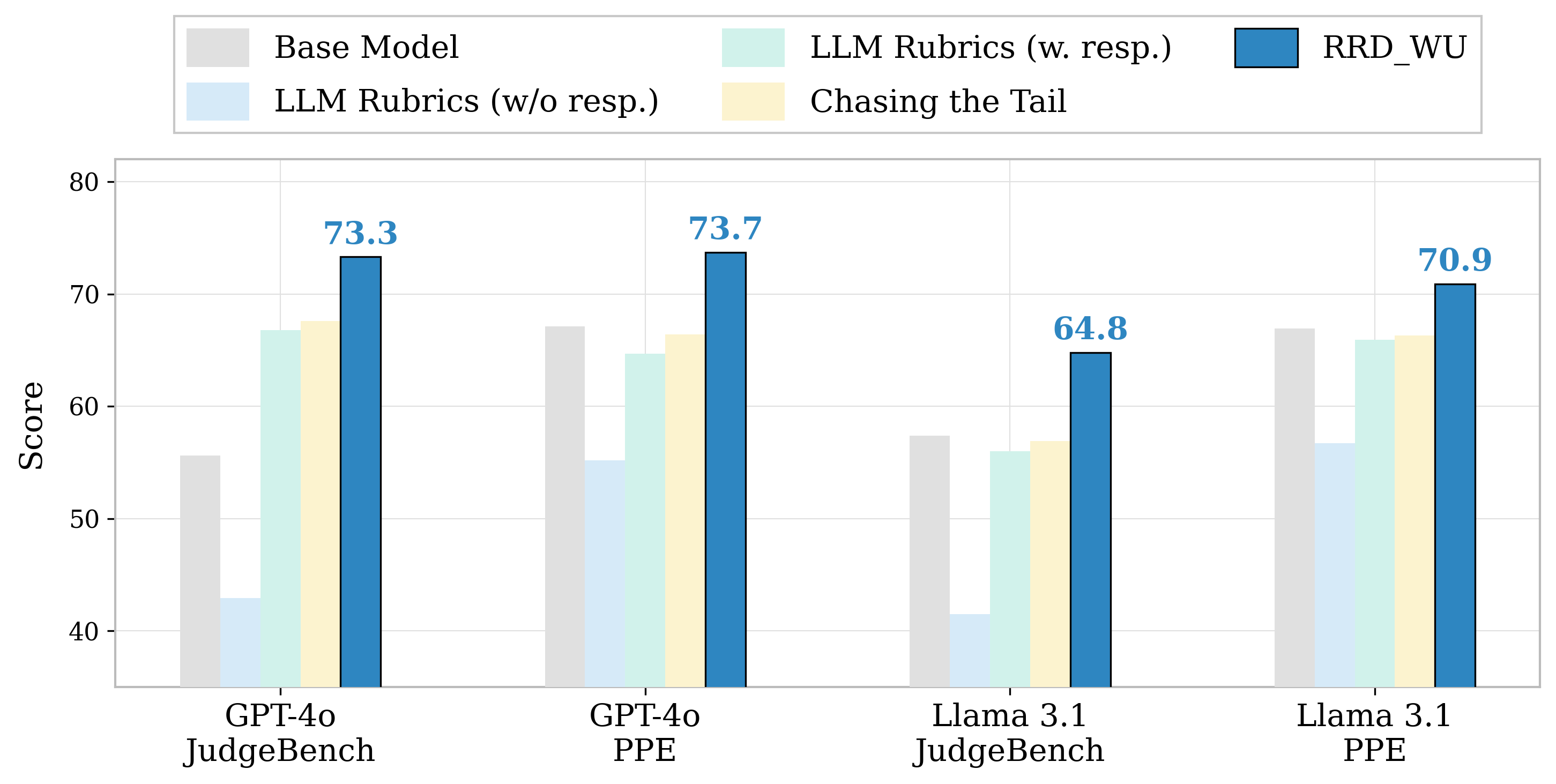
Recently, rubrics have been used to guide LLM judges in capturing subjective, nuanced, multi-dimensional human preferences, and have been extended from evaluation to reward signals for reinforcement fine-tuning (RFT). However, rubric generation remains hard to control: rubrics often lack coverage, conflate dimensions, misalign preference direction, and contain redundant or highly correlated criteria, degrading judge accuracy and producing suboptimal rewards during RFT. We propose RRD, a principled framework for rubric refinement built on a recursive decompose-filter cycle. RRD decomposes coarse rubrics into fine-grained, discriminative criteria, expanding coverage while sharpening separation between responses. A complementary filtering mechanism removes misaligned and redundant rubrics, and a correlation-aware weighting scheme prevents over-representing highly correlated criteria, yielding rubric sets that are informative, comprehensive, and non-redundant. Empirically, RRD delivers large, consistent gains across both evaluation and training: it improves preference-judgment accuracy on JudgeBench and PPE for both GPT-4o and Llama3.1-405B judges, achieving top performance in all settings with up to +17.7 points on JudgeBench. When used as the reward source for RFT on WildChat, it yields substantially stronger and more stable learning signals, boosting reward by up to 160% (Qwen3-4B) and 60% (Llama3.1-8B) versus 10-20% for prior rubric baselines, with gains that transfer to HealthBench-Hard and BiGGen Bench. Overall, RRD establishes recursive rubric refinement as a scalable and interpretable foundation for LLM judging and reward modeling in open-ended domains.