Prompts to Proxies: Emulating Human Preferences via a Compact LLM Ensemble
P2P uses adaptive prompting and L1-regularized regression to build compact LLM ensembles that emulate human preferences at low cost without fine-tuning. It achieves 0.014 test MSE on American Trends Panel surveys for about $0.80 each and outperforms supervised baselines with under 3% of their traini
Published 2026Sydney Poster Session 2 · Tue, Dec 8, 5:00 PM–8:00 PM local time · Hall 1-4arXiv ↗OpenReview ↗
Only vote on papers you've read. Sign in with GitHub to vote.
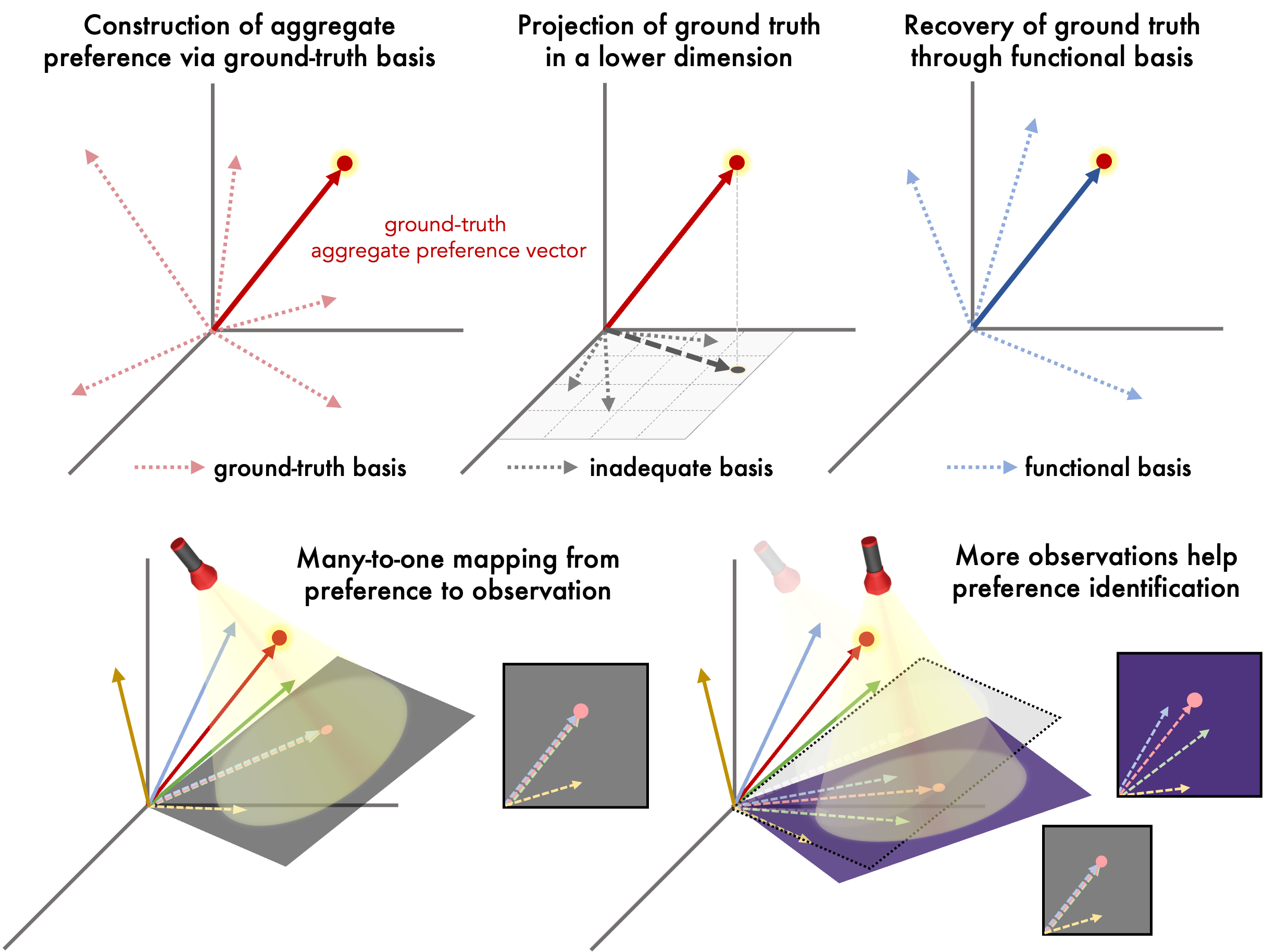
Abstract
Large language models are increasingly used as proxies for human subjects in social science research, yet external validity requires that synthetic agents faithfully reflect the preferences of target human populations. We introduce *preference reconstruction theory*, a framework that formalizes preference alignment as a representation learning problem: constructing a functional basis of proxy agents and recovering population preferences through weighted aggregation. We implement this via *Prompts to Proxies* ($\texttt{P2P}$), a modular two-stage system. Stage 1 uses structured prompting with entropy-based adaptive sampling to construct a diverse agent pool spanning the latent preference space. Stage 2 employs L1-regularized regression to select a compact ensemble whose aggregate response distributions align with observed data from the target population. $\texttt{P2P}$ requires no finetuning and no access to sensitive demographic data, incurring only API inference costs. We validate the approach on 14 waves of the American Trends Panel, achieving an average test MSE of 0.014 across diverse topics at approximately 0.8 USD per survey. We additionally test it on the World Values Survey, demonstrating its potential to generalize across locales. When stress-tested against an SFT-aligned baseline, $\texttt{P2P}$ achieves competitive performance using less than 3% of the training data.