Guaranteed Noisy CP Tensor Recovery via Riemannian Optimization on the Segre Manifold
Riemannian optimization on the Segre manifold recovers noisy low-CP-rank tensors via RGD and RGN, which achieve linear and quadratic-to-linear convergence under mild noise.
Published 2026Atlanta Poster Session 6 · Fri, Dec 11, 4:30 PM–7:30 PM local time · Hall C1arXiv ↗OpenReview ↗
Only vote on papers you've read. Sign in with GitHub to vote.
Abstract
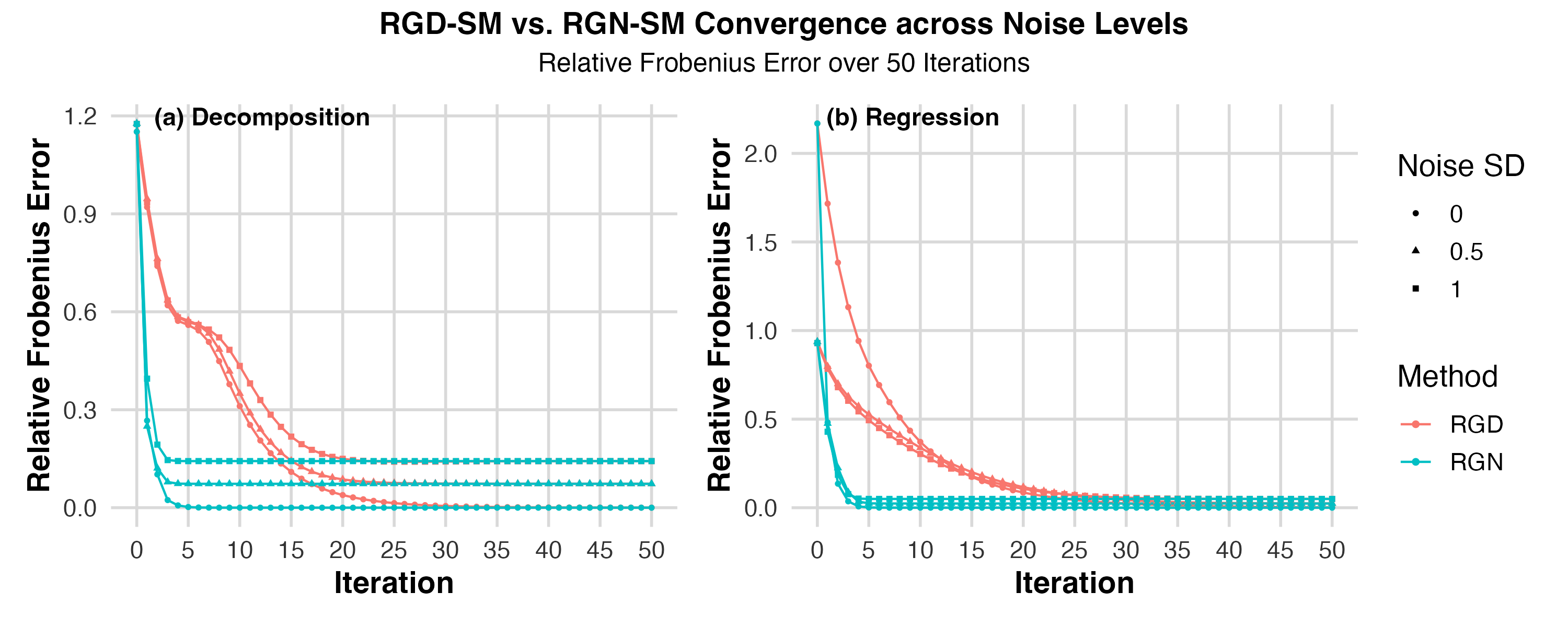
Recovering a low-CP-rank tensor from noisy linear measurements is a central challenge in high-dimensional data analysis, with applications spanning tensor PCA, tensor regression, and beyond. We exploit the intrinsic geometry of rank-one tensors by casting the recovery task as an optimization problem over the Segre manifold, the smooth Riemannian manifold of rank-one tensors. This geometric viewpoint yields two powerful algorithms: Riemannian Gradient Descent (RGD) and Riemannian Gauss-Newton (RGN), each of which preserves feasibility at every iteration. Under mild noise assumptions, we prove that RGD converges at a local linear rate, while RGN exhibits an initial local quadratic convergence phase that transitions to a linear rate as the iterates approach the statistical noise floor. Extensive synthetic experiments validate these convergence guarantees and demonstrate the practical effectiveness of our methods.