COMPOT: Calibration-Optimized Matrix Procrustes Orthogonalization for Transformers Compression
COMPOT proposes training-free transformer compression via orthogonal dictionaries and closed-form sparse factorization with dynamic layer-wise budget allocation. It achieves superior quality-compression trade-offs versus low-rank and sparse baselines and integrates with quantization.
Published 2026Sydney Poster Session 6 · Thu, Dec 10, 5:00 PM–8:00 PM local time · Hall 1-4▲ 9 on Hugging FacearXiv ↗OpenReview ↗
Only vote on papers you've read. Sign in with GitHub to vote.
Abstract
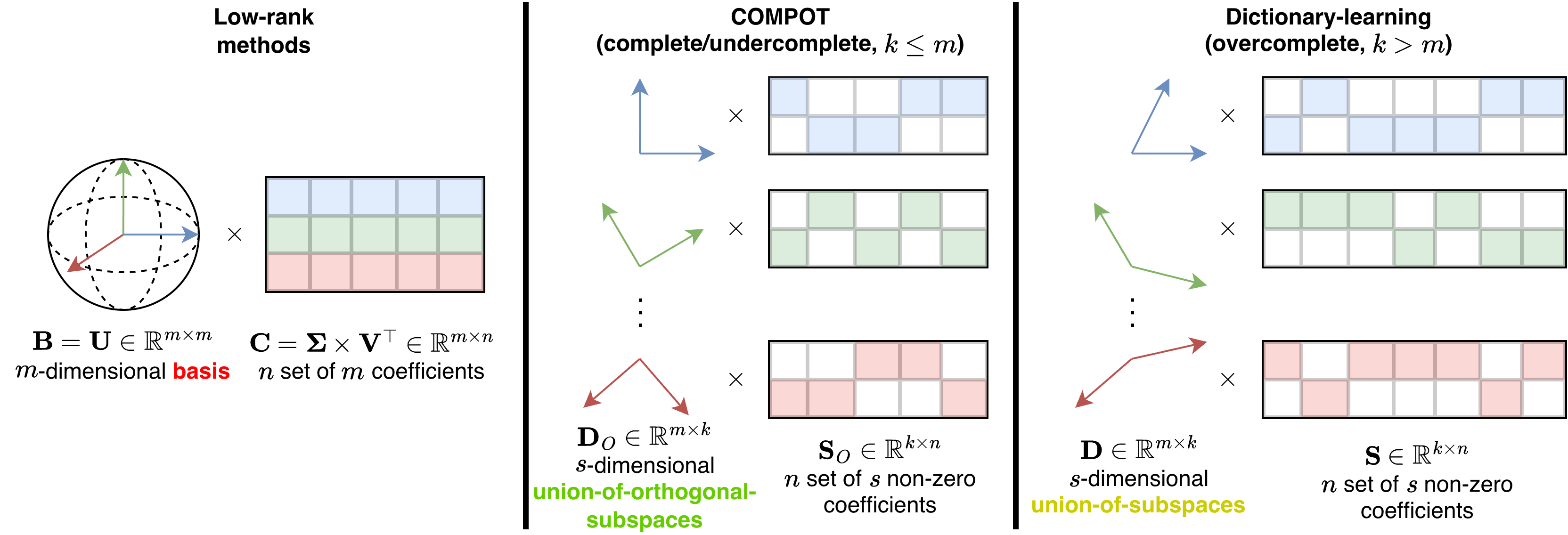
Post-training compression of Transformer models commonly relies on truncated singular value decomposition (SVD). However, enforcing a single shared subspace can degrade accuracy even at moderate compression. Sparse dictionary learning provides a more flexible union-of-subspaces representation, but existing approaches often suffer from iterative dictionary and coefficient updates. We propose COMPOT (Calibration-Optimized Matrix Procrustes Orthogonalization for Transformers), a training-free compression framework that uses a small calibration dataset to estimate a sparse weight factorization. COMPOT employs orthogonal dictionaries that enable closed-form Procrustes updates for the dictionary and analytical single-step sparse coding for the coefficients, eliminating iterative optimization. To handle heterogeneous layer sensitivity under a global compression budget, COMPOT further introduces a one-shot dynamic allocation strategy that adaptively redistributes layer-wise compression rates. Extensive experiments across diverse architectures and tasks show that COMPOT consistently delivers a superior quality-compression trade-off over strong low-rank and sparse baselines, while remaining fully compatible with post-training quantization for extreme compression. Code is available $\href{https://github.com/mts-ai/COMPOT}{here}$.