Information Loss and Disparate Effects in Network Embeddings
Baseline network embeddings cause information loss scaling with graph density and assortativity, yielding identical limits for different SBM graphs that disproportionately raise link prediction errors for smaller, sparser communities.
Published 2026Sydney Poster Session 6 · Thu, Dec 10, 5:00 PM–8:00 PM local time · Hall 1-4arXiv ↗OpenReview ↗
Only vote on papers you've read. Sign in with GitHub to vote.
Abstract
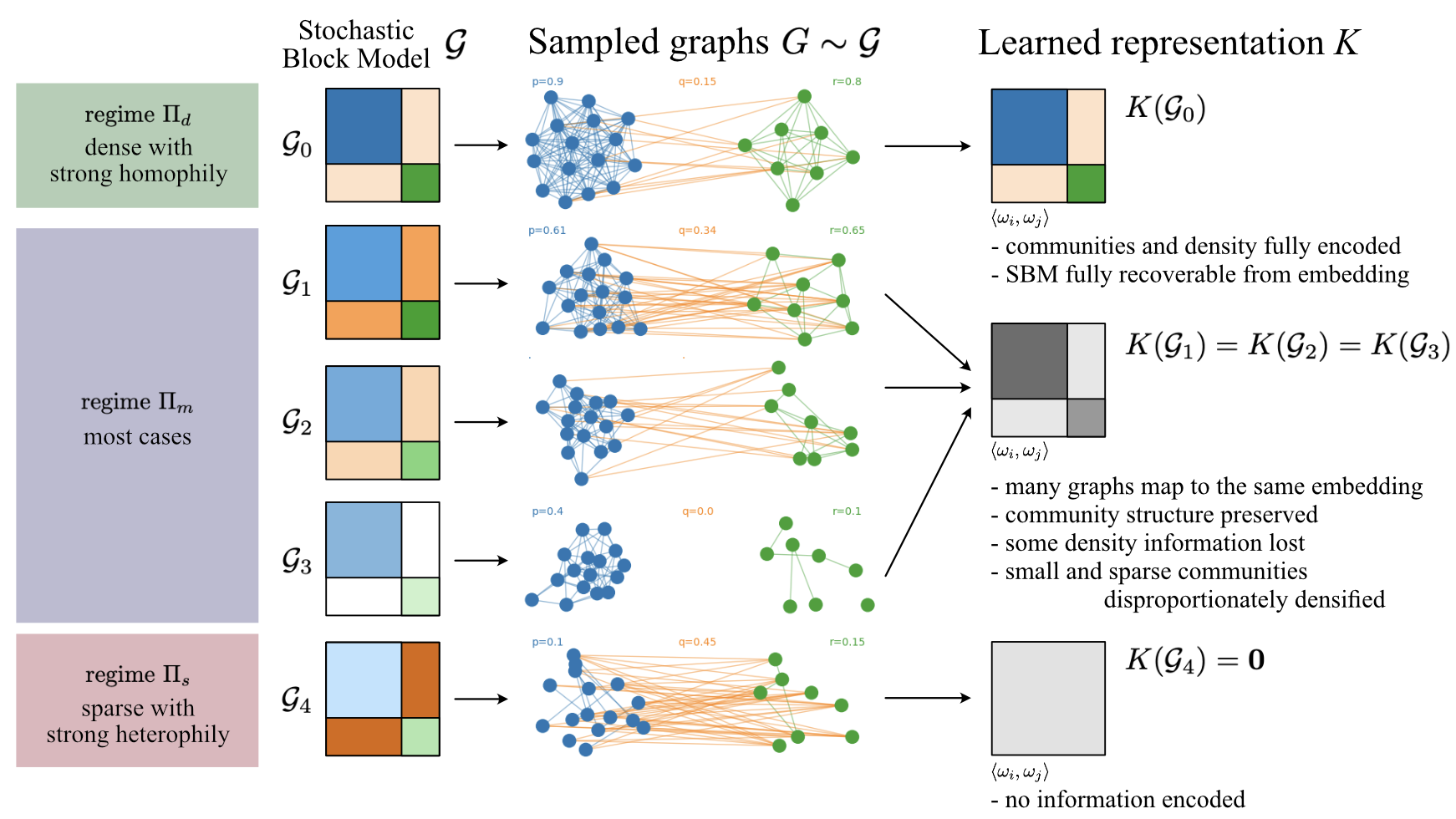
An extensive line of work studies fairness interventions for network embeddings, but less is known about their baseline behavior. In this work, we ask: how do baseline embeddings (without fairness interventions) produce disparate effects at the representation level? We analyze the asymptotic behavior of low-dimensional embeddings on stochastic block model (SBM) graphs, which encode both homophily and group structure. We characterize exact conditions under which embeddings cause information loss, showing that the amount of information loss depends directly on the graph's density and assortativity. Notably, very different graphs can produce identical embeddings in the limit, and this non-invertibility disproportionately affects smaller and sparser communities. As a result, simple downstream tasks, such as link prediction, introduce higher error rates for these communities, helping explain disparities widely observed in practice.