Network of Theseus (Like the ship)
Network of Theseus progressively replaces guide network modules with a different target architecture via representational alignment, preserving performance across vastly different deployed architectures.
Published 2026Sydney Poster Session 5 · Thu, Dec 10, 10:00 AM–1:00 PM local time · Hall 1-4arXiv ↗OpenReview ↗
Only vote on papers you've read. Sign in with GitHub to vote.
Abstract
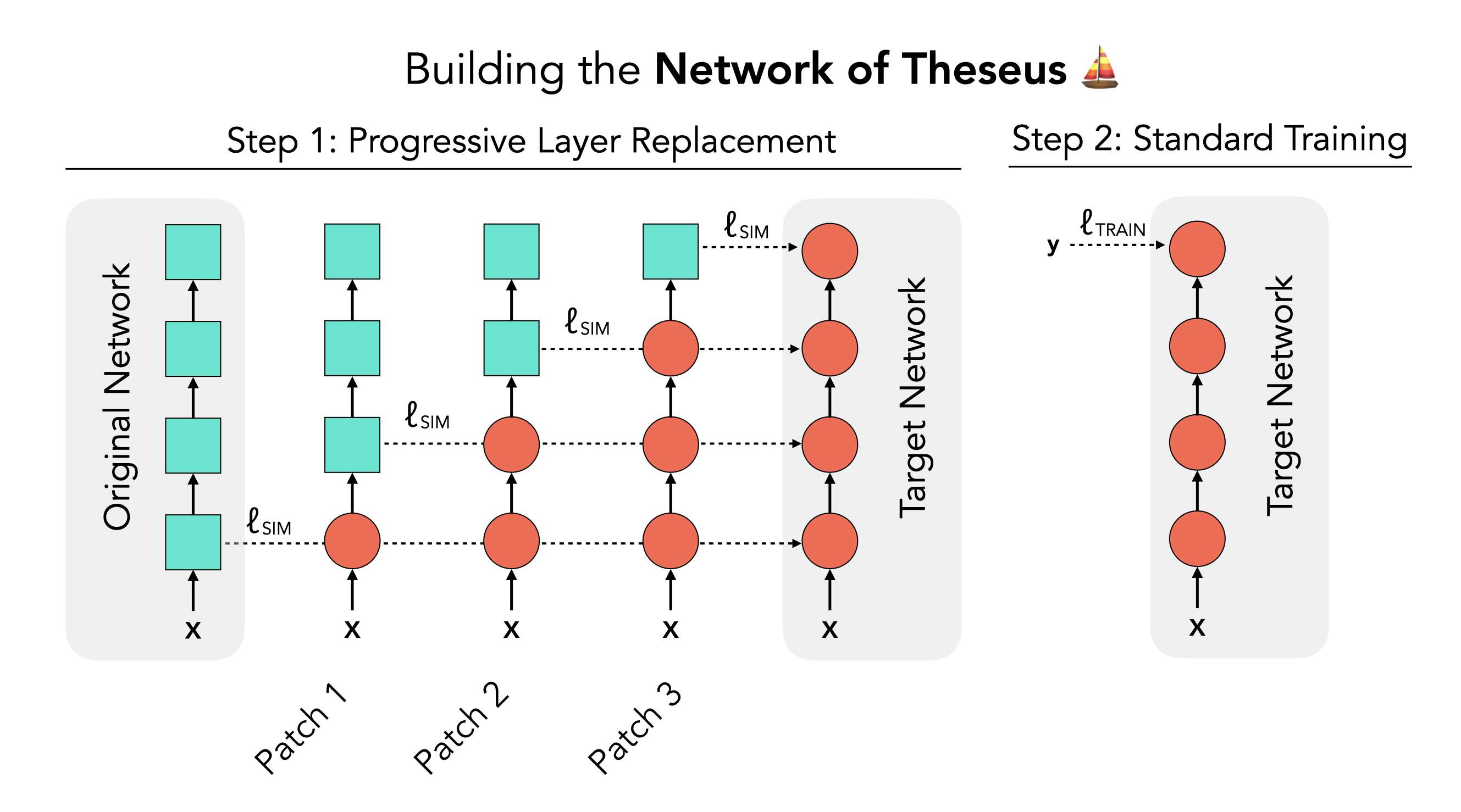
A standard assumption in deep learning is that the inductive bias introduced by a neural network architecture must persist from training through inference. The architecture you train with is the architecture you deploy. This assumption constrains the community from selecting architectures that may have desirable efficiency or design properties due to difficulties with optimization. We challenge this assumption with Network of Theseus (NoT), a method for progressively converting a trained, or even untrained, guide network architecture part-by-part into an entirely different target network architecture while preserving the performance of the guide network. At each stage, components in the guide network architecture are incrementally replaced with target architecture modules and aligned via representational similarity metrics. This procedure largely preserves the functionality of the guide network even under substantial architectural changes-for example, converting a convolutional network into a multilayer perceptron, or GPT-2 into a recurrent neural network. By decoupling optimization from deployment, NoT expands the space of viable inference-time architectures, opening opportunities for better accuracy-efficiency tradeoffs and enabling more directed exploration of the architectural design space.