BrainVista: Modeling Naturalistic Brain Dynamics as Multimodal Next-Token Prediction
BrainVista models brain dynamics via multimodal next-token prediction with network tokenizers and stimulus masking, achieving state-of-the-art fMRI encoding and up to 36% better long-horizon rollout correlations.
Published 2026Sydney Poster Session 4 · Wed, Dec 9, 5:00 PM–8:00 PM local time · Hall 1-4arXiv ↗OpenReview ↗
Only vote on papers you've read. Sign in with GitHub to vote.
Abstract
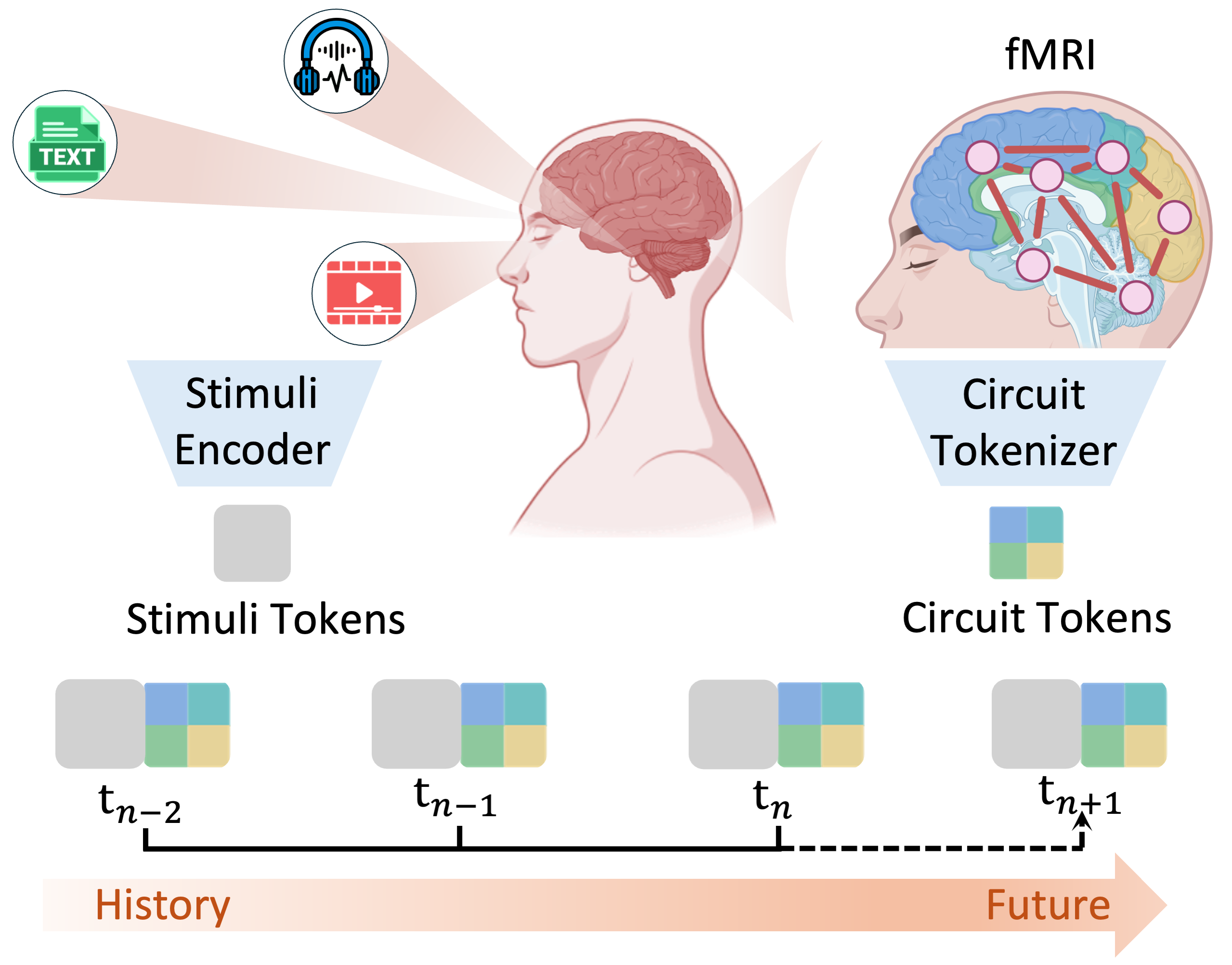
Naturalistic fMRI characterizes the brain as a dynamic predictive engine driven by continuous sensory streams. However, modeling the causal forward evolution in realistic neural simulation is impeded by the timescale mismatch between multimodal inputs and the complex topology of cortical networks. To address these challenges, we introduce BrainVista, a multimodal autoregressive framework designed to model the causal evolution of brain states. BrainVista incorporates Network-wise Tokenizers to disentangle system-specific dynamics and a Spatial Mixer Head that captures inter-network information flow without compromising functional boundaries. Furthermore, we propose a novel Stimulus-to-Brain (S2B) masking mechanism to synchronize high-frequency sensory stimuli with hemodynamically filtered signals, enabling strict, history-only causal conditioning. We validate our framework on Algonauts 2025, CineBrain, and HAD, achieving state-of-the-art fMRI encoding performance. In long-horizon rollout settings, our model yields substantial improvements over baselines, increasing pattern correlation by 36.0\% and 33.3\% on relative to the strongest baseline Algonauts 2025 and CineBrain, respectively.