LEVDA: Latent Ensemble Variational Data Assimilation via Differentiable Dynamics
LEVDA is a latent ensemble variational smoother using differentiable neural dynamics to assimilate sparse irregular observations without adjoint models, improving accuracy and uncertainty quantification over baselines.
Published 2026Sydney Poster Session 6 · Thu, Dec 10, 5:00 PM–8:00 PM local time · Hall 1-4arXiv ↗OpenReview ↗
Only vote on papers you've read. Sign in with GitHub to vote.
Abstract
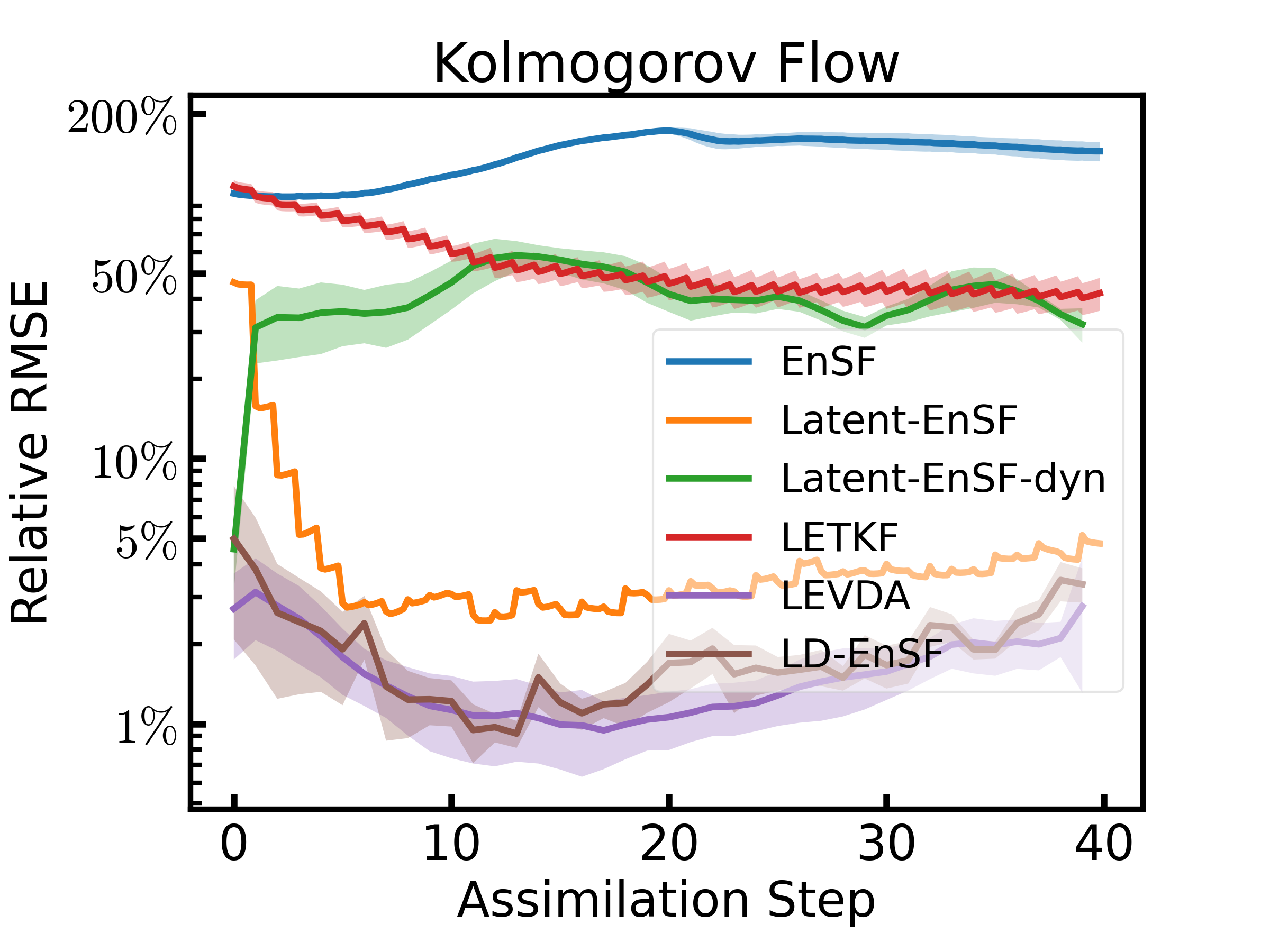
Long-range geophysical forecasts are fundamentally limited by chaotic dynamics and numerical errors. While data assimilation can mitigate these issues, classical variational smoothers require computationally expensive tangent-linear and adjoint models. Conversely, recent efficient latent filtering methods often enforce weak trajectory-level constraints and assume fixed observation grids. To bridge this gap, we propose Latent Ensemble Variational Data Assimilation (LEVDA), an ensemble-space variational smoother that operates in the low-dimensional latent space of a pretrained differentiable neural dynamics surrogate. By performing four-dimensional ensemble-variational (4DEnVar) optimization within an ensemble subspace, LEVDA jointly assimilates states and unknown parameters without the need for adjoint code or auxiliary observation-to-latent encoders. Leveraging the fully differentiable, continuous-in-time-and-space nature of the surrogate, LEVDA naturally accommodates highly irregular sampling at arbitrary spatiotemporal locations. Across three challenging geophysical benchmarks, LEVDA matches or outperforms state-of-the-art latent filtering baselines under severe observational sparsity while providing more reliable uncertainty quantification. Simultaneously, it achieves substantially improved assimilation accuracy and computational efficiency compared to full-state 4DEnVar.