Lifting Biomolecular Data Acquisition
Neural compressed sensing extends to function space to co-design wet-lab experiments with learning algorithms, achieving orders-of-magnitude higher information density by measuring multiple molecules simultaneously and deconvolving activity during training for antibodies and cell therapies.
Published 2026Paris Poster Session 1 · Wed, Dec 9, 12:30 PM–2:30 PM local time · Paris Poster HallarXiv ↗OpenReview ↗
Only vote on papers you've read. Sign in with GitHub to vote.
Abstract
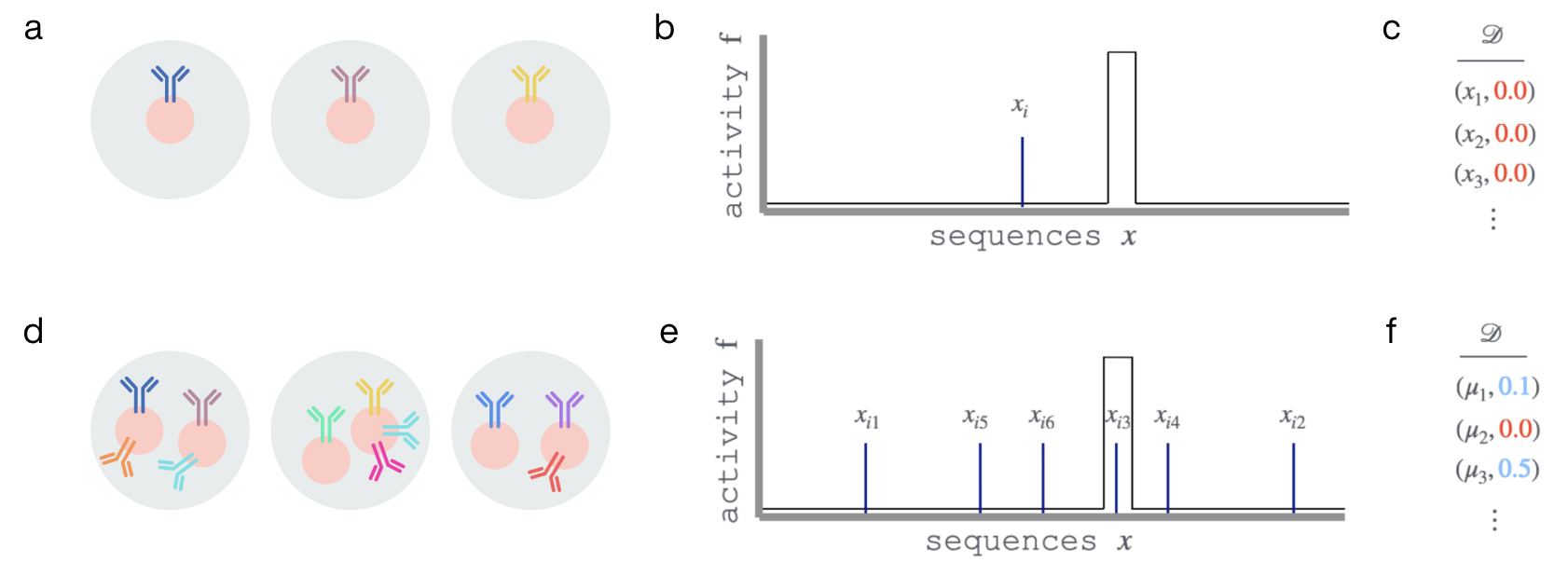
One strategy to scale up ML-driven science is to increase wet lab experiments' information density. We present a method based on a neural extension of compressed sensing to function space. We measure the activity of multiple different molecules simultaneously, rather than individually. Then, we deconvolute the molecule-activity map during model training. Co-design of wet lab experiments and learning algorithms provably leads to orders-of-magnitude gains in information density. We demonstrate on antibodies and cell therapies.