Z0-Inf: Zeroth Order Approximation for Data Influence
Z0-Inf estimates data influence via zeroth-order checkpoint losses, achieving efficient, accurate self-influence and train-test influence estimation for large language models without gradients.
Published 2026Atlanta Poster Session 1 · Wed, Dec 9, 10:00 AM–1:00 PM local time · Hall C1arXiv ↗OpenReview ↗
Only vote on papers you've read. Sign in with GitHub to vote.
Abstract
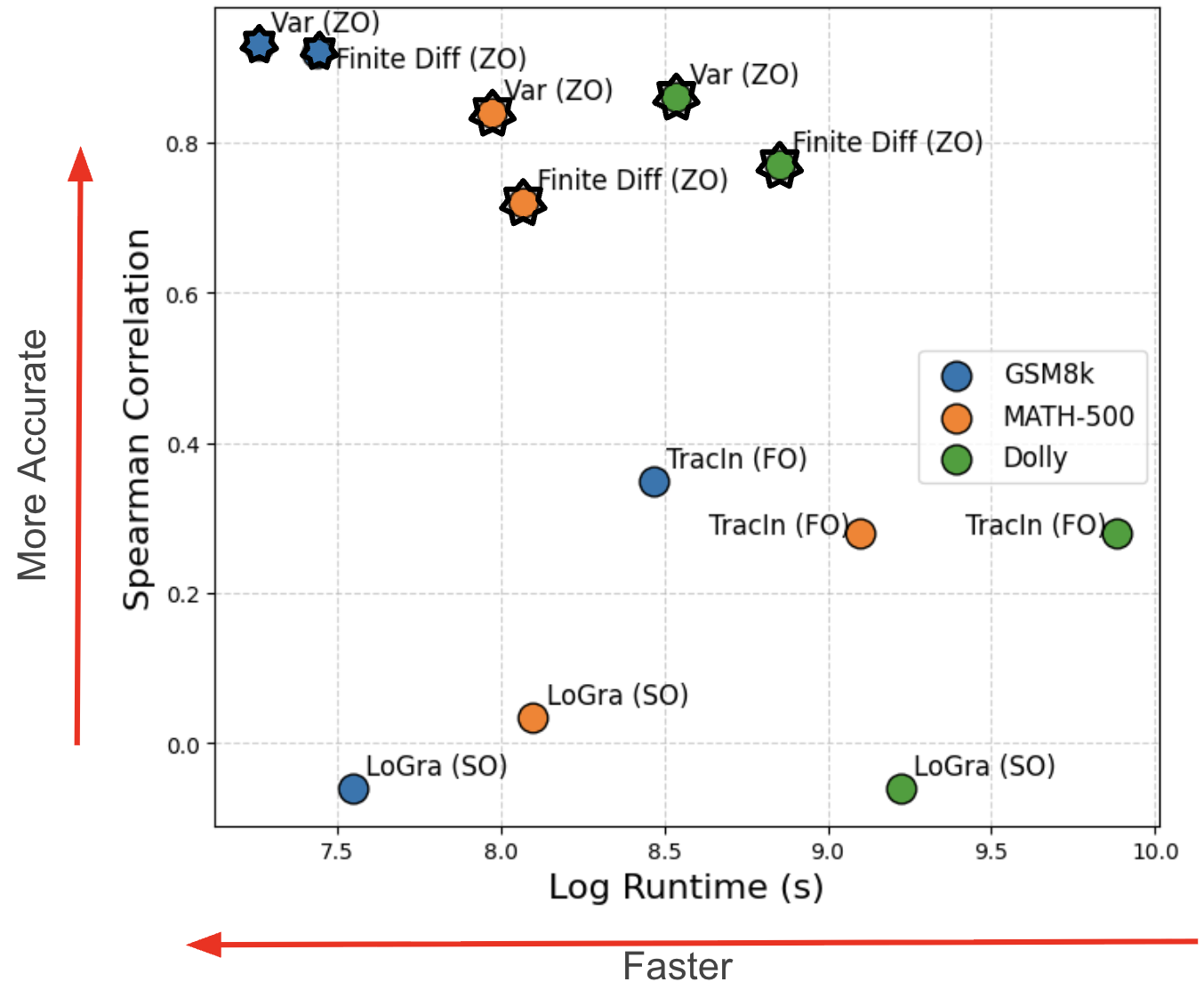
A critical aspect of analyzing and improving modern machine learning systems lies in understanding how individual training examples influence a model's predictive behavior. Estimating this influence enables critical applications, including data selection and model debugging; in particular, self-influence, which quantifies the influence of a training point on itself, has found many uses in data quality assessment and outlier detection. Existing methods for measuring data influence, however, are often impractical for large models due to low accuracy or prohibitive computational costs: most approaches either provide poor approximations or rely on gradients and inverse-Hessian computations that remain challenging to scale. In this work, we introduce a highly efficient zeroth-order approximation for estimating the influence of training data that requires only a fraction of the time and memory footprint of prior methods. Notably, our method relies solely on loss values of intermediate checkpoints on the training and test data, along with the checkpoints themselves, making it broadly applicable even when the loss function of interest is non-differentiable. Beyond its computational efficiency, our approach achieves superior accuracy in estimating self-influence and comparable or improved accuracy in estimating train-test influence for fine-tuned large language models, enabling scalable and practical analysis of how training data shapes model behavior.