Do We Always Need Query-Level Workflows? Rethinking Agentic Workflow Generation for Multi-Agent Systems
Task-level workflows often match query-level coverage, and the SCALE framework cuts token costs by up to 83% with minimal accuracy loss.
Published Jan 16, 2026arXiv ↗
Only vote on papers you've read. Sign in to vote.
Abstract
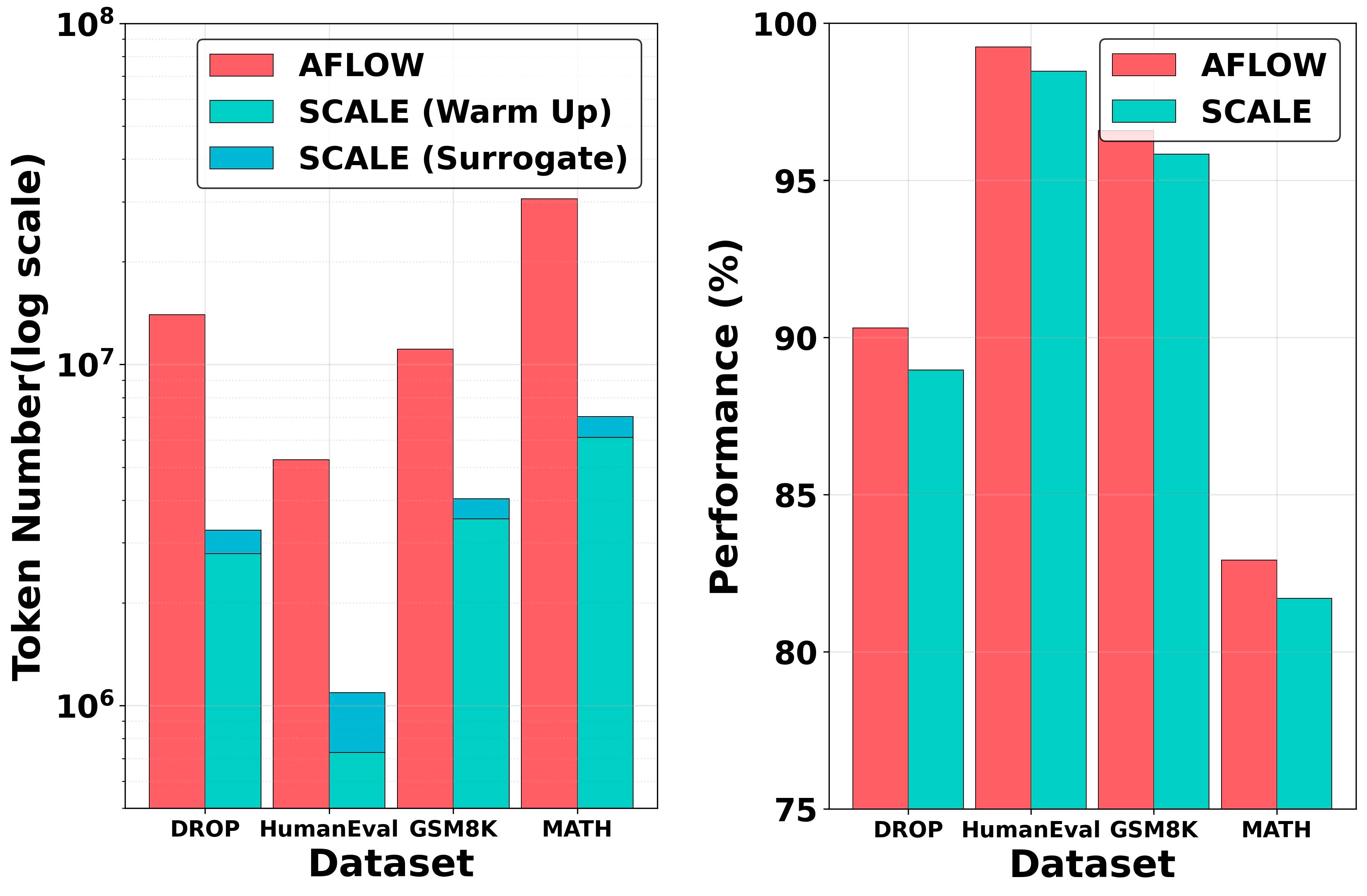
Multi-Agent Systems (MAS) built on large language models typically solve complex tasks by coordinating multiple agents through workflows. Existing approaches generates workflows either at task level or query level, but their relative costs and benefits remain unclear. After rethinking and empirical analyses, we show that query-level workflow generation is not always necessary, since a small set of top-K best task-level workflows together already covers equivalent or even more queries. We further find that exhaustive execution-based task-level evaluation is both extremely token-costly and frequently unreliable. Inspired by the idea of self-evolution and generative reward modeling, we propose a low-cost task-level generation framework \textbf{SCALE}, which means \underline{\textbf{S}}elf prediction of the optimizer with few shot \underline{\textbf{CAL}}ibration for \underline{\textbf{E}}valuation instead of full validation execution. Extensive experiments demonstrate that \textbf{SCALE} maintains competitive performance, with an average degradation of just 0.61\% compared to existing approach across multiple datasets, while cutting overall token usage by up to 83\%.